
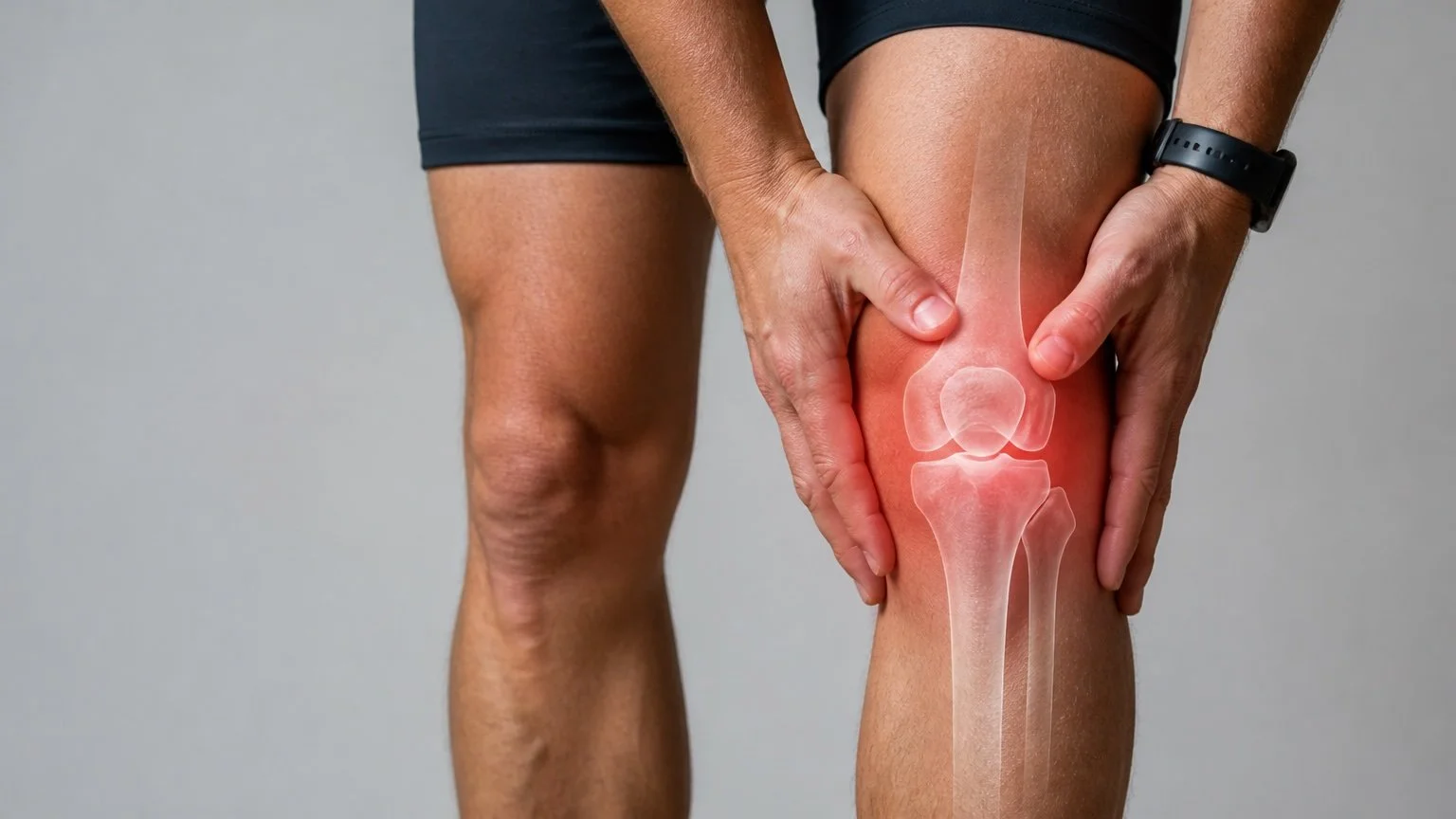
Knee pain treatment
Ongoing knee pain that hasn’t settled with usual treatments can significantly impact quality of life. Symptoms can be treated with a minimally-invasive procedure called Genicular Artery Emoblisation.
ABOUT CHRONIC KNEE PAIN
What causes chronic knee pain?
The most common cause of long-term knee pain is osteoarthritis (OA) — inflammatory “wear and tear” of the joint. Many different structures around the knee can contribute to knee pain. Pain is the body sensing an inflammatory response to injury, infection, or tissue stress. Pain that hasn’t settled or is recurring within three months is considered chronic.
The inflammation causes abnormal new blood vessels to grow into the joint lining, and tiny new nerves grow alongside them. These new vessels and nerves are a major source of ongoing pain — and they are the target of GAE.
What is genicular artery embolisation?
Genicular Artery Embolisation (GAE) is a newer, minimally invasive procedure for knee pain from osteoarthritis. The genicular arteries are the small arteries that supply the knee. An interventional radiologist uses X-ray guidance to find the abnormal, inflamed blood vessels in your knee and blocks them with tiny particles. This reduces inflammation and pain, while the normal blood supply to the knee is preserved.
There are no surgical cuts, no general anaesthetic, and you go home the same day.
Who is it for?
GAE may be suitable if you have:
Knee pain from mild to moderate osteoarthritis
Pain that has not improved enough with exercise, physiotherapy, weight loss, pain medicines or injections
A wish to avoid or delay knee replacement surgery — or you are not fit enough for surgery
GAE tends to work best in earlier arthritis. This is important: if you have early-onset OA, surgeons often try to delay knee replacement for as long as possible (artificial knees can wear out and need redo surgery). GAE can help bridge that gap — controlling pain for months to years without burning any bridges. Having GAE does not cause problems if you need a knee replacement later.
GAE is not suitable if you have an active infection in the knee, a previous knee replacement in that knee, poor circulation in the leg, or certain other conditions — your specialist will check for these.
Where does GAE fit? The treatment ladder
Knee OA is usually treated step by step. A sensible pathway looks like this:
Conservative care first — physiotherapy, muscle strengthening, weight loss and activity changes. This is the foundation for everyone.
Oral pain medicines — paracetamol and anti-inflammatories, added as needed.
Doctor review and imaging — if pain persists, your GP should re-check the diagnosis (other problems like a pinched nerve in the back or joint infection can mimic knee arthritis) and arrange X-rays or other scans.
Corticosteroid injection (CSI) — an anti-inflammatory injection into the joint. Relief is often good but usually lasts weeks to a few months.
Hyaluronic acid injections (such as Efluxxa or Durolane) — a lubricating gel injection, often combined with corticosteroid, which may give longer relief.
Genicular Artery Embolisation (GAE) — for pain that keeps coming back despite the steps above.
Knee surgery — usually total knee replacement, for advanced arthritis when other options are exhausted.
Clinical Precision specialises in GAE listed in step 6.
Talk to us about whether this procedure is right for you
ABOUT THE PROCEDURE
What happens on the day?
You point out exactly where your knee hurts, and this is marked to guide the procedure.
You are given light sedation to keep you relaxed, plus local anaesthetic to numb the skin.
A thin tube (catheter) is placed into an artery at the groin through a tiny nick in the skin.
Using X-ray guidance and contrast dye, the abnormal vessels in the painful parts of your knee are found.
Tiny particles are injected to block these vessels. The normal arteries are protected.
The tube is removed and pressure is applied — no stitches needed. The procedure takes about 60–90 minutes.
Recovery
You rest for a few hours afterwards and go home the same day.
You cannot drive for 24 hours after sedation, so please arrange a lift.
Mild knee soreness or a patch of skin discolouration near the knee can occur for a few days — this settles on its own.
Most people are back to normal activities within a day or two.
Pain relief builds over the following weeks as the inflammation settles
How well does it work?
Most studies show meaningful improvement in pain and function, often lasting 6 months to 2 years in those who respond well.
Many patients reduce their use of pain medicines afterwards.
Results are better in mild to moderate arthritis than in severe, “bone-on-bone” disease.
GAE is still a relatively new procedure. Research is ongoing, and some studies suggest part of the benefit may come from factors other than the embolisation itself. Your specialist will discuss the evidence honestly so you can make an informed choice.
What are the risks?
What are the risks?
GAE is very safe. Serious complications are rare. Possible issues include:
Bruising at the groin (common, settles quickly)
Temporary skin discolouration or numb patches around the knee (usually resolves on its own)
Vascular spasm or injury due to catheterisation
Rarely, a small area of skin ulceration, or a reaction to the X-ray dye
Next steps
If knee pain is limiting your life despite physiotherapy, medicines or injections — or you want to delay knee surgery — talk to your GP about a referral to Clinical Precision in Geelong. Our interventional radiologist will review your scans and symptoms, make sure the pain is truly coming from the knee joint, and help you choose the right step on the ladder — whether that’s an injection, GAE, or referral onward.
For referring practitioners: please include knee X-ray and any MRI reports, a summary of treatments trialled to date, and relevant specialist correspondence. A detailed referrer information sheet is available on request.